ChAMELEON · Lectures and summer school

Computational and mAthematical MEthods in machine LEarning, Optimization and iNference

A lecture and a summer school developed over the last couple of years by Andreas Mang in the Department of Mathematics at the University of Houston.

days
5
lectures
8
invited talks
2
participants
41
institutions
10
posters
9

August 11–15, 2025 · University of Houston

Summer School 2025

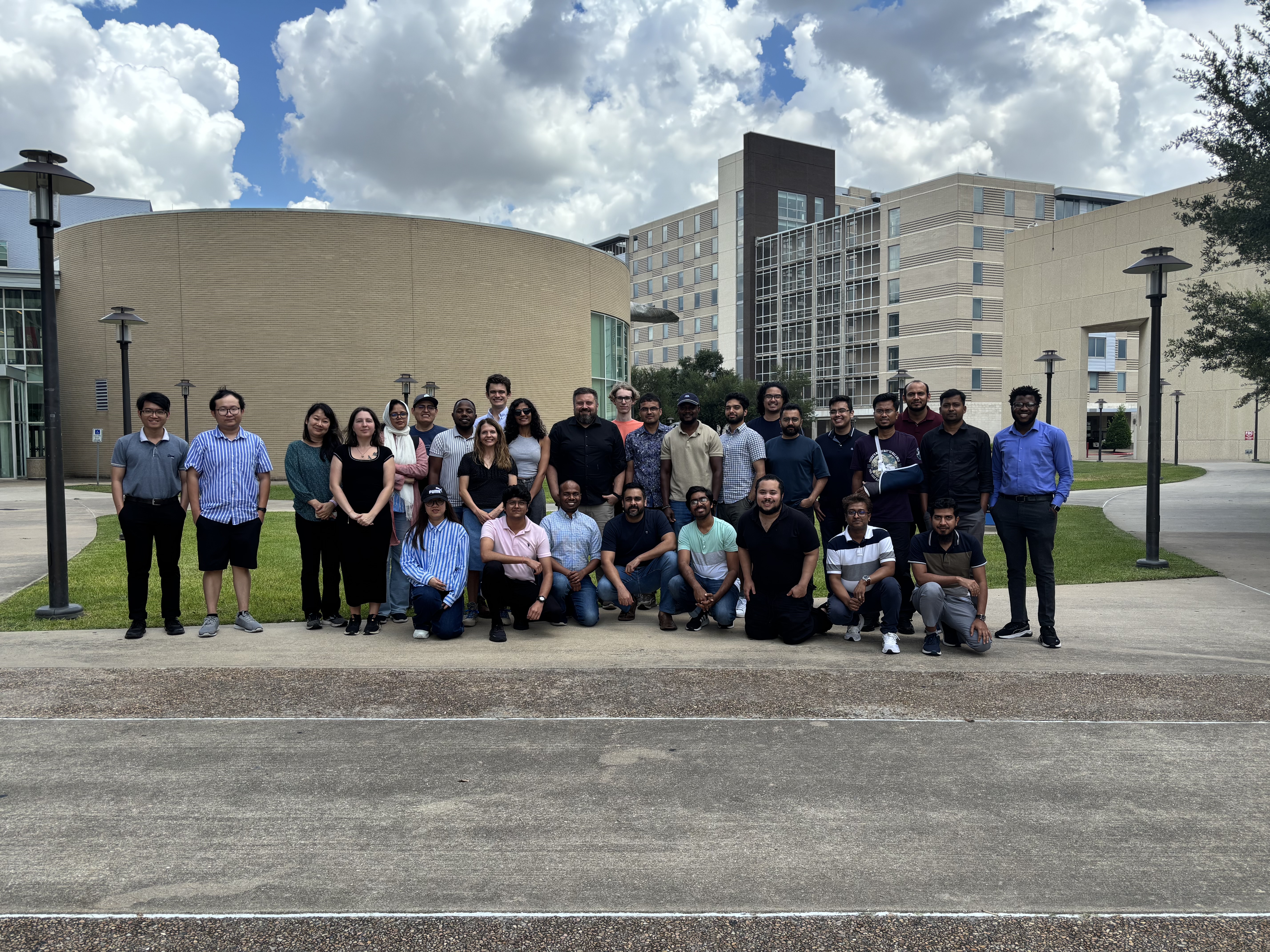
Group photo of the participants of the ChAMELEON Summer School 2025 on the University of Houston campus
Participants of the first ChAMELEON summer school, August 2025.

This one-week summer school introduced participants to mathematical techniques at the intersection of machine learning, inverse problems, and statistical inference, with an emphasis on numerical aspects. Mornings included lectures that provided a foundational understanding of the field. Participants learned about state-of-the-art approaches for solving both deterministic and statistical inverse problems of varying complexity. In the afternoons, participants engaged in hands-on assignments to gain practical experience. They learned how to execute code on a modern high-performance computing architecture.

The summer school also featured research talks by leading scientists in the field. Participants also had the opportunity to present their research results during a poster session.

Mornings

Lecture topics

The 8 lectures covered the following topics.

01

Introduction to Inverse Problems

Forward and inverse problems and the notion of well-posedness, motivated by linear regression, denoising, deblurring, computed tomography, inverse heat conduction, inverse scattering, tumor modeling, and image registration.

02

Spectral Operator Theory in Inverse Problems

The singular value decomposition of matrices and compact operators, the Picard condition, and how spectral decay causes ill-posedness; spectral regularization such as truncated SVD, Tikhonov regularization, and Landweber iteration, and how to choose the regularization parameter.

03

Convex Optimization

Convex sets and functions, projections, Fenchel conjugates, Lagrangian duality, and the KKT optimality conditions.

04

Convex Non-Smooth Optimization

Subgradient methods, proximal operators and the Moreau envelope, proximal gradient methods, and ADMM, with sparsity-promoting problems such as the LASSO as a running example.

05

Optimization in Machine Learning

Iterative shrinkage-thresholding (ISTA and FISTA) and its learned, unrolled counterpart LISTA, along with adaptive gradient methods such as AdaGrad, RMSProp, and Adam.

06

Inverse Problems Governed by Dynamical Systems

Inverse problems constrained by partial differential equations, from the inverse heat equation to large-scale applications: discretization, adjoint-based sensitivities, reduced-space Newton–Krylov methods, preconditioning, and scalability on CPUs and GPUs.

07

Numerical Methods for Machine Learning

Numerical building blocks behind learning algorithms, including finite-difference discretizations, derivative checks, and line-search methods.

08

Bayesian Inverse Problems

Likelihood and prior modeling, the posterior in finite dimensions and in function space, connections to Tikhonov regularization, MAP estimation and the Laplace approximation, sampling with Metropolis–Hastings and preconditioned Crank–Nicolson, variational inference, hierarchical models, and optimal experimental design.

Afternoons

Hands-on sessions

Afternoons were devoted to hands-on assignments that combined analysis with computing in Python on the high-performance computing cluster of the Research Computing Data Core at the University of Houston. Problems ranged from well-posedness, least squares, convexity, derivative checks, and proximal operators to eigenfunction expansions for the heat equation and learned ISTA (LISTA) for denoising handwritten digits.

Code templates on GitHub

August 11–15, 2025

Schedule

  • Lectures and talks
  • Breakout and Q&A
  • Independent work
  • Lunch
Time MondayTuesdayWednesdayThursdayFriday
09:00–10:30 Lecture 1Lecture 3Lecture 5Lecture 7Talk
10:30–11:00 BreakoutBreakoutBreakoutBreakoutBreakout
11:00–12:30 Lecture 2Lecture 4Lecture 6Lecture 8Talk
12:30–13:00 Q&AQ&AQ&AQ&A
13:00–14:30 LunchLunchLunchLunch
14:30–17:00 Independent WorkIndependent WorkIndependent WorkIndependent Work

Friday

Invited research talks

The summer school featured two virtual research talks.

Community

Participants and posters

Over 40 participants attended the first installment of this summer school. They discussed the presented material, worked on project assignments related to the material covered during the lectures, and participated in a poster presentation.

Institutions represented

  • University of Houston 29
  • Rice University 4
  • North Dakota State University 1
  • New Mexico State University 1
  • Trinity University 1
  • University of Houston-Downtown 1
  • University of Texas at Dallas 1
  • North Carolina State University 1
  • UT MD Anderson Cancer Center 1
  • Riphah International University, Lahore Campus 1

Learn more

Resources

Code templates

Python code for problems discussed during the summer school, including linear and logistic regression, derivative checks for regularized least-squares problems, line-search optimization, k-means clustering, and a multilayer perceptron trained on MNIST.

github.com/andreasmang/chameleon

Further reading

Inverse problems
Optimization
Uncertainty quantification
Data science and machine learning

Support

U.S. National Science Foundation logo

The summer school was financially supported by NSF under the award DMS-2145845 and by the Research Computing Data Core at the University of Houston.